Showing posts with label zero books. Show all posts
Showing posts with label zero books. Show all posts
Friday, 1 October 2010
Millennial Melancholy
"I never wanted to big up any drugs, because I don't reckon they deserve it. It's just something that you choose to do. I probably come across as, like, 'Yeah, acid and weed are amazing.' But I don't think that at all, really. And if I did, I wouldn't want to say it in an interview. Plus, I'm never under the influence of drugs when I make music. Whenever I have been, it's always been totally rubbish. It's a real disciplined thing, making music. When you're tripping, you're just fucked. You could never get it together to make a track. When I'm stoned, I go to bed."
"only with programming you have to use your brain. The most important thing is that it should have some emotional effect on me, rather than just, 'Oh, that's really clever.' There's a lot of melancholy in my tracks." His best ones, he says, are those which evoke feelings that can't quite be described, where "you're not quite sure what emotion it is".
(Richard D. James, 'The Friday Interview: Aphex Twin', The Guardian, 05/10/2001: http://www.guardian.co.uk/culture/2001/oct/05/artsfeatures3)
"These distinctions matter because the way out of this mess (and it is a mess, fuelled by ignorance, stupidity, prejudice and weapons) is to clarify and discriminate rather than hurl abuse at anything that goes near a mosque.
I doubt many Muslims can be bothered with Amis. But he nurtures in his audience a corrosive prejudice against people they've never bothered to meet. It is culturally dim for us to form confident opinions about people based upon how they look and what we've heard they think. It is also against our interests. Nonsense abounds on the causes of terrorism but it is hard to argue that alienation doesn't channel potential foot soldiers towards radicalisation. As one solitary Muslim asked him at the ICA, 'Why such contempt for Muslims?' Amis must have known something was up because he dropped his drawl and called the man 'sir'. But he could hardly unspeak his views. And those views are certainly alienating."
(Chris Morris, 'The Absurd World of Martin Amis', The Guardian, 25/11/2007, http://www.guardian.co.uk/commentisfree/2007/nov/25/bookscomment.religion)
Carl Neville's Classless: Recent Essays on British Film, another fine Zero book, identifies the late-1990s as a time in which There Was No Alternative - to consumerist hedonism or its political parent, Blairism. When ideas and learning were restricted (and the culturally highbrow buried ever deeper in the schedules), popular culture itself lost out through lacking any contrast or focal point to rally against. It became the establishment; one that we now need to recognise as intensely problematic.
In the late 1990s, there was a resistance, embodied best perhaps by two figures, Chris Morris and Richard D. James (aka. Aphex Twin). Morris, educated at Jesuit Stonyhurst, is of course best known for The Day Today and Brass Eye, but for me the initial few series of Blue Jam and in part Jam, make up the pinnacle of his work and define the late 90s era like nothing else.
If his earlier work was a liberal savaging of tabloid Toryism and stupidity in all its forms, Blue Jam tapped into the nation's nervous systems, fears and desires laid bare: a forensic representation of a national unconscious. There is a languid quality; strong, almost primal emotions sometimes, others a completely detachment - always a serene melancholia.
Some fragments bite all the harder now for all of the subsequent 'Noughties' history: the middle-class couple's sex arrangement in return for slight reductions in house price. The Middle England couple's campaign to get their child into the 'right school', as mentioned in an excellent post by Nina Power here: http://infinitethought.cinestatic.com/index.php/5324/. The man bowing out in his prime; an ambiguous reflection on euthanasia and the narcissistic self-image of the Baby Boomer generation. The sublimely timed Mr Bentham sketches, depicting the quiet nightmare of Consultancy Britain.
The musical soundtrack is perfectly judged to create the mood of alternating unease and sadness: Morris' choices tap into a thoughtful strain of British music, electronic and ambient. The music of BJ forms an eloquent expression of his own singular qualities: articulacy, eccentricity, insight, precision. His best work in Blue Jam makes one think of Pinter, as well as Cook and Stanshall. The music is rooted in a time when the 1960s/70s born musicians began developing a hauntological music (in its more populist form, Lemon Jelly, in its more abstract, Position Normal; its most euro-electro, Broadcast).
The soundtrack Bark Psychosis. Brian Eno. Thomas Dolby. Gainsbourg. David Sylvian. The Cardigans heartrending ('Celia Inside'). PJ Harvey at her most haunting. Recontextualised 'Oh Lori' by Alessi, chilling lost summers. Reflective city music: Mono, Dubstar and Alpha.
And Aphex. Always Aphex.
The magnificent SAW2 does not need recounting; perhaps The Richard D. James Album does - an electronic symphony of English Weirdness. 'Windowlicker' is the seminal single that should have taken us into a different universe, but somehow didn't. Even Drukqs is essential; or, at least half of it is: the miraculous 'Btoum-Roumada', the uncanny 'Father' which evokes Allan Gray's spiralling piano tones in A Matter of Life and Death. The AFX Analord series is artful evidence of his growing into an elder statesman role, as dubstep, Ghost Box and Mordant Music arrived. Morris went on to make the vitally important (if occasionally slightly lax) Brass Eye Special, the flawed London media satire Nathan Barley (some valid digs at the line-quoting hero-worshipping of him in the treatment of Dan Ashcroft by 'The Idiots'; some great moments, but ultimately little of the satirical bite or scope of his previous work) and most recently, the commendable Four Lions. Not a great film overall, but a humane statement of libertarian-left sanity in an ever more sensationalised, reductive media landscape.
For millennial melancholy, one might also cite the retrospection of Black Box Recorder and, of cours,e Radiohead, whose sequence of albums from OK Computer to Hail to the Thief display no illusions about their times, as well as US bands like Lambchop and Sparklehorse. Perhaps my favourite record of this time remains Bows' absurdly overlooked Blush (1999), with Long Fin Killie's Luke Sutherland fusing diverse elements: urbane trip-hop, sedated Drum & Bass, aquatic strings, abstract harps, Scandinavian female vocals and a post-rock undertow.
Morris and James are so much more than the lazy stereotype of 'media terrorists', of people 'pushing the boundaries of acceptable taste', yawn. True, they cut through cant and politesse, but are not empty nihilists out to shock. They rather display a clear-sighted humanity, and, at their peak, an extraordinary discipline in the causes of intelligence and feeling.

Sunday, 27 June 2010
The Bronze Generation fall short once again, surprise surprise!

So, England were favourites were they? Idiotic pundits saying that no more than one or two German players would 'get in the England team', without evidence for such assertions. Form put Germany ahead - 2 wins and 6 goals in their previous 3 games, in comparison to England's mere 2 goals and 5 points. Superstitious commentators cannot even raise their usual, ludicrous complaint that England weren't wearing red!

The media feeds the players' and fans' sense of entitlement: that England are somehow inherently one of the best teams in the world, regardless of their performances as a team. It is all for the better that they were beaten so comfortably today - the scoreline flattered England frankly, it could have been 8-2 - as the media and fans cannot simply blame the officials and FIFA as they might have done had it been a tight 2-1 win. Blaming the foreigner is a time worn pursuit for those immersed in English football. It can happen no longer - all must take a long hard look at these players and ask: 'why do we rate them so highly?' They were atrocious today - to call the defending schoolboy would be an insult to children. The likes of John Terry simply are not world-class if they cannot defend simple punts upfield from the opposing goalkeeper.
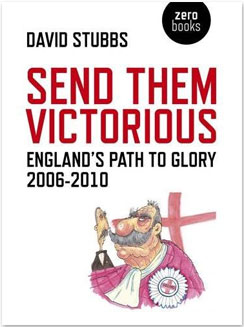
David Stubbs captures this idiocy in his wonderfully droll Send Them Victorious (Zero Books, 2010), which should be required reading in schools and workplaces across the country. The Wing Commander is a superb creation; a crotchety old buffer and remnant of the empire: like a cross between Viv Stanshall's Sir Henry Rawlinson and Willie Donaldson's Henry Root. An eccentric, but avowedly right-wing old reprobate who combines the imperialism of Empire with the absurd sense of entitlement many armchair fans feel today. There are other excellent creations, such as the equally convincing Scottish pundit who rues the days of football played by real men hewn from granite and the Arsenal fan, nay, connoisseur who calls them 'Artenal'.
Friday, 12 February 2010
'We tried to stand for nothing, now there's nothing to stand for'
Education is about trying to make what is complex seem manageable and achievable for students - it is about raising the bar, the standards, without it even being realised at first.
- a personal credo; thoughts brought on by experiences at work, The Bodines' 'Heard It All' (looping on iTunes forever), Adam Curtis, and this urgent, very 2010 northern pop requiem:
Why always requiems? Because there's a bloody lot to mourn, sat here waiting for a new culture to come into being, to supplant that of the last 25 years. 'Sat here', writing and thinking is better than nothing at all. Even if I am not achieving anything like what is being done by Zero Books, I am writing about what I care about, rather than merely larking around 100% of the time, because 'nothing really matters'. Did Freddie Mercury mean that line...? Maybe not, but too many have taken it as a defining philosophy.
What started as a game
Became a chore before too long
The lyrics are still elliptical, cryptical, only more so. Importantly open to serious interpretation. This cannot help but make me think of the general malaise of British and postmodernist culture; so much less healthy a culture than the vigorous democracy of 1966 captured in this film that Adam Curtis embeds in this blog here:
http://www.bbc.co.uk/blogs/adamcurtis/2010/02/do_people_heckle.html#comments
A vital contrast to the depopulated shards of Sunderland captured in Field Music's video.
Where once we asked for lessons
Now it's all to be ignored
How do we trust the speaker
When his calling is to calm
Ever more exlicitly, this accords with Adam Curtis' oft-repeated trope that the media seeks to pacify through fear. The command to 'chill'. The resort to charity as an end in itself, heads-in-the-sand-as-regards-politics since Live Aid / Miner's Strike. The withdrawal into private space. The delusions of the casually anarchic, refusing truly to learn anything... The absurd delusions fostered by the Positive Thinking industry.
This music is part of a minor renaissance in thinking British music that happens to use guitars: the xx, Wild Beasts, Los Campesinos!, plus older hands like Camera Obscura, Richard Hawley and The Clientele.
If we worked hard and behaved,
We'd be anything we choose
This gets the past mantra of my FE alma matter, the COSC (City of Sunderland College), to a tee! 'Be who you want to be' and all the PR guff, though strangely enough it did allow me to do so. Like Alan Bennett, I refuse to bite the hand that feeds. State education; the ideals should be enshrined, the reality constantly improved.
Postmodern British Education often omits learning which goes beyond the script (mere study guides and pure exam focus), and allows the learner to forge their own path. If this was to be nurtured, you will have citizens who can think critically for life. Obsessions, love and hates, autodidactism need to be accommodated and nurtured within the broad curriculum for state-school pupils and FE state college students. That 4000 word piece I was able to write at the COSC on the 1979 Winter of Discontent opened my mind in so many ways: the curricular focus on seeing all sides and weighing up evidence was intensely helpful, enabling me to rationalise and contextualise my previously vague, if strongly felt, left-wing leanings. The A2 Extended Project - which I have a professional interest in - affords this chance; it is a real release for those students who seriously approach it at A Level. The moot question being: can this sort of thing ever be rolled out to all?
Steering back from professional reflection, I would urge readers to investigate the Field Music corpus; not just as they are also from Sunderland*, but because the Brewis Brothers produce music that is at times magnificent: check out the School of Language and The Week That Was albums, as well as the current 72-minute album. There is deft deployment of field recordings, appositely enough, and echoes of 'Penny Lane', XTC and the Beach Boys through John Carter's imagining (those chords from 01:57 of 'Something Familiar', evoking the grand canyons of the final section of Stamford Bridge's 'Arizona Lost and Gone'). 'Precious Plans' if anything cuts even deeper than 'Them That Do Nothing', reflecting the submerged dreams of townfulls, refracting back to me so much in and of myself.
A telling passage from a recent interview here; my emphasis added by italics:
'What sort of music were the young Brewises listening to when they were teaching their protégé? "Mine and Peter's first musical love was Led Zeppelin - not that you could tell that from the first two albums. As I got older I became kind of embarrassed of that and ignored the stuff I used to like. There was a lot I didn't like about that sort of music - the sexism, the self indulgence and hippy mentality that really grates on me. But it's a shame to let the great things about it escape.
"When I first started writing songs I was very shy and embarrassed about everything and there was a kind of conviction against rock mythology. You know, people might say Oasis's first albums were great and stuff, but to me the kind of attitude they've fostered, I wanted to go in completely the opposite direction. Noel Gallagher seems an intelligent guy, but then he says that he never learnt anything at school and things like that, and I think 'You total dick - you don't really think that'. It's patronising. It's such a cliché. Actually, I'm a fan of clichés - they can be great if you take them in a different context and convert them. Bands like Roxy Music took cliché and turned it into something else." '
http://www.musicomh.com/music/features/field-music_0110.htm
Also, these posts are along the same lines as some points I've been making:
http://k-punk.abstractdynamics.org/archives/011486.html
http://deformablemirror.blogspot.com/2010/02/psychedelic-dungeons-popping-up-on.html
* New Field Music bassist Ian Black was in my class at Barnes Junior School.
- a personal credo; thoughts brought on by experiences at work, The Bodines' 'Heard It All' (looping on iTunes forever), Adam Curtis, and this urgent, very 2010 northern pop requiem:
Why always requiems? Because there's a bloody lot to mourn, sat here waiting for a new culture to come into being, to supplant that of the last 25 years. 'Sat here', writing and thinking is better than nothing at all. Even if I am not achieving anything like what is being done by Zero Books, I am writing about what I care about, rather than merely larking around 100% of the time, because 'nothing really matters'. Did Freddie Mercury mean that line...? Maybe not, but too many have taken it as a defining philosophy.
What started as a game
Became a chore before too long
The lyrics are still elliptical, cryptical, only more so. Importantly open to serious interpretation. This cannot help but make me think of the general malaise of British and postmodernist culture; so much less healthy a culture than the vigorous democracy of 1966 captured in this film that Adam Curtis embeds in this blog here:
http://www.bbc.co.uk/blogs/adamcurtis/2010/02/do_people_heckle.html#comments
A vital contrast to the depopulated shards of Sunderland captured in Field Music's video.
Where once we asked for lessons
Now it's all to be ignored
How do we trust the speaker
When his calling is to calm
Ever more exlicitly, this accords with Adam Curtis' oft-repeated trope that the media seeks to pacify through fear. The command to 'chill'. The resort to charity as an end in itself, heads-in-the-sand-as-regards-politics since Live Aid / Miner's Strike. The withdrawal into private space. The delusions of the casually anarchic, refusing truly to learn anything... The absurd delusions fostered by the Positive Thinking industry.
This music is part of a minor renaissance in thinking British music that happens to use guitars: the xx, Wild Beasts, Los Campesinos!, plus older hands like Camera Obscura, Richard Hawley and The Clientele.
If we worked hard and behaved,
We'd be anything we choose
This gets the past mantra of my FE alma matter, the COSC (City of Sunderland College), to a tee! 'Be who you want to be' and all the PR guff, though strangely enough it did allow me to do so. Like Alan Bennett, I refuse to bite the hand that feeds. State education; the ideals should be enshrined, the reality constantly improved.
Postmodern British Education often omits learning which goes beyond the script (mere study guides and pure exam focus), and allows the learner to forge their own path. If this was to be nurtured, you will have citizens who can think critically for life. Obsessions, love and hates, autodidactism need to be accommodated and nurtured within the broad curriculum for state-school pupils and FE state college students. That 4000 word piece I was able to write at the COSC on the 1979 Winter of Discontent opened my mind in so many ways: the curricular focus on seeing all sides and weighing up evidence was intensely helpful, enabling me to rationalise and contextualise my previously vague, if strongly felt, left-wing leanings. The A2 Extended Project - which I have a professional interest in - affords this chance; it is a real release for those students who seriously approach it at A Level. The moot question being: can this sort of thing ever be rolled out to all?
Steering back from professional reflection, I would urge readers to investigate the Field Music corpus; not just as they are also from Sunderland*, but because the Brewis Brothers produce music that is at times magnificent: check out the School of Language and The Week That Was albums, as well as the current 72-minute album. There is deft deployment of field recordings, appositely enough, and echoes of 'Penny Lane', XTC and the Beach Boys through John Carter's imagining (those chords from 01:57 of 'Something Familiar', evoking the grand canyons of the final section of Stamford Bridge's 'Arizona Lost and Gone'). 'Precious Plans' if anything cuts even deeper than 'Them That Do Nothing', reflecting the submerged dreams of townfulls, refracting back to me so much in and of myself.
A telling passage from a recent interview here; my emphasis added by italics:
'What sort of music were the young Brewises listening to when they were teaching their protégé? "Mine and Peter's first musical love was Led Zeppelin - not that you could tell that from the first two albums. As I got older I became kind of embarrassed of that and ignored the stuff I used to like. There was a lot I didn't like about that sort of music - the sexism, the self indulgence and hippy mentality that really grates on me. But it's a shame to let the great things about it escape.
"When I first started writing songs I was very shy and embarrassed about everything and there was a kind of conviction against rock mythology. You know, people might say Oasis's first albums were great and stuff, but to me the kind of attitude they've fostered, I wanted to go in completely the opposite direction. Noel Gallagher seems an intelligent guy, but then he says that he never learnt anything at school and things like that, and I think 'You total dick - you don't really think that'. It's patronising. It's such a cliché. Actually, I'm a fan of clichés - they can be great if you take them in a different context and convert them. Bands like Roxy Music took cliché and turned it into something else." '
http://www.musicomh.com/music/features/field-music_0110.htm
Also, these posts are along the same lines as some points I've been making:
http://k-punk.abstractdynamics.org/archives/011486.html
http://deformablemirror.blogspot.com/2010/02/psychedelic-dungeons-popping-up-on.html
* New Field Music bassist Ian Black was in my class at Barnes Junior School.
Friday, 27 November 2009
Zero Books - recommendations
Just received this today, before its supposed date of publication! 300 or so pages, 23 writers, including many vital voices:
http://www.amazon.co.uk/Resistible-Demise-Michael-Jackson/dp/1846943485
Some more fine work from a publisher that doesn't talk down to its readers, nor intimidates. Accessible, eloquent polemics for these times:
'Where have the interesting women gone?'
http://www.amazon.co.uk/One-Dimensional-Woman-Nina-Power/dp/1846942411/ref=pd_sim_b_3
A European Modernism reclaimed and asserted
http://www.amazon.co.uk/Militant-Modernism-Zero-Books-Hatherley/dp/1846941768/ref=pd_sim_b_5
'A ruthless portrait of our ideological misery'
http://www.amazon.co.uk/Capitalist-Realism-There-No-Alternative/dp/1846943175/ref=pd_sim_b_1
N.P. The Jacksons, 'Show You the Way to Go' (1976)
http://www.amazon.co.uk/Resistible-Demise-Michael-Jackson/dp/1846943485
Some more fine work from a publisher that doesn't talk down to its readers, nor intimidates. Accessible, eloquent polemics for these times:
'Where have the interesting women gone?'
http://www.amazon.co.uk/One-Dimensional-Woman-Nina-Power/dp/1846942411/ref=pd_sim_b_3
A European Modernism reclaimed and asserted
http://www.amazon.co.uk/Militant-Modernism-Zero-Books-Hatherley/dp/1846941768/ref=pd_sim_b_5
'A ruthless portrait of our ideological misery'
http://www.amazon.co.uk/Capitalist-Realism-There-No-Alternative/dp/1846943175/ref=pd_sim_b_1
N.P. The Jacksons, 'Show You the Way to Go' (1976)
Subscribe to:
Posts (Atom)


