Showing posts with label the guardian. Show all posts

Sunday, 12 June 2011

Adventures Behind Enemy Lines... Part 1

This was fair comment, delivered with a conviction that the Leader of the Opposition could do with mustering. I decided to follow the discussion on that bastion of the Right, the Daily Telegraph, and the Guardian on the left-hand side.

The Guardian had a predictable amount of knee-jerk atheist attacks on Williams, which did not address the content of what he said. I assume some of these were right-wing 'trolls' trying to sway general Guardian-reader opinion against the Archbishop's comments - trying to play upon the readership's general skepticism towards religion.

The Torygraph had several comments to the same sort of effect, but putting across more of an emphasis on Williams's supposed socialism or - most absurdly - his status as a Marxist guerilla about to destroy the nation. This sort of hysterical inexactitude was the type of thing I had not really encountered for years; perhaps going back to my days as intermittent contributions to a UK political 'news-group'. The right-of-centre people I have encountered in person have largely been polite and I am able to have a reasonable discussion with them.

There were a few somewhat rational comments, critical of Williams, but the DT commenting crowd seems to be comprised of would-be retired Majors or bitter, infantile 'libertarians', pushing Hayek's The Road to Serfdom as their holy text. If one is after an insight into what it is to be incoherently angry and misanthropic, you could do worse than check out the Daily Telegraph's comment-threads.

Upon reading, I was so exasperated that I decided I would have a go at posting - under the moniker 'ordnancesurly', taken from a song of mine. Clearly any attempt to 'get through' to these people will be 99% wasted effort, but I thought... why not have a go at reasoning with them and see what emerges? Try and plant a few seeds of doubt.

There were multiple articles assailing Williams, but I alighted on two in particular; firstly one from Benedict Brogan, he of the John Majorish accountant's accountant-style Tory visage. Deputy editor of the paper, no less.

There were a reasonable number of sane, agreeable commentators:
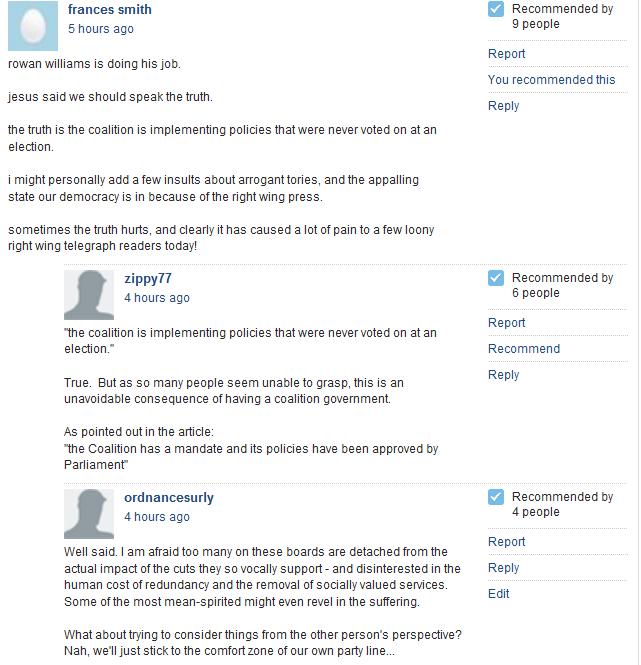

But then there were the absurdly sanctimonious Thatcher fans, talking about toxicity without reference to the Iron Lady as the defining influence on modern Blighty:


Needless to say, there was no response to my last points.

I was baffled by the odd religious 'vision' of jeongu, which they were not willing to clarify for me:


Dynamic phrases such as 'the frocked coward' are routine on these boards. People without any sense of balance or even awareness of how even-handed Williams has been in his comments:


I was able to probe the perennial post-Thatcher Tory tensions: between loving the free-market and hating immigration, the EU and immigrants:


I note the maniacal conspiracy theorist, PP, who provides no link to evidence backing up his fraud claim or the electoral statistics that would prove it made the difference:


Such absurd hyperbole from Edward Green, that made me link to this famous old clip of Jimmy from The Fall and Rise of Reginald Perrin - oh, and yes: I got told to read Hayek, after suggesting that the bellicose nutter might read a true 'conservative' like Edmund Burke... 


'Rabid emotionalism' seems about right to me. Their 'realism' is a fantasy:


They conflate individuals' debt with government debt; the old 'we've maxed out the nation's credit card!' stupidity, again not fully understanding Rowan Williams's longer-term position and consistency:

The above bit on the role of the church was actually my first entrance into the debate, highlighting what I would have thought were obvious points.

The other article that was graced by an ordnancesurly intervention was a shoddy piece of work from Cristina Odorne, bizarrely - on this evidence - a former deputy-editor of The New Statesman. An admitted Tory voter in 2010, Odorne is also a Catholic, and one would at least expect a temperate view to be taken with the head of the Church of England. However, she attempted to score points in precisely the manner she was accusing Williams of doing. This is truly the sort of journalistic trifle that could have been thrown together without even having read RW's words, and makes Brogan's comments seem a model of sanity in comparison. It is a stock response that one can imagine she had filed away ready for the next time Williams came into the news. When it turns out that his comments are not slavishly approving of the Tory policies of the Coalition, then it is fair game for the attack dogs to be unleashed!

Attack dogs who do not fail to trot out this sort of tired nonsense, which has been thoroughly discredited post-economic crisis, if it was not before:


It was good to have had some support in the debate, as from norto here. While I suspect he/she (though, he really... when have women been known as avid frequenters of DT comments-threads?!) may be a bit of a Blue Labourite, good points were made. 


This article did receive far more critical comments, attacking the style of writing and half-baked arguments, but there was still a nauseating level of support - as one would expect:


I made a few more contributions to that thread, but I think that is an appropriate note to end on. I doubt I will be logging onto the DT's site on a regular basis - it would frankly be a waste of time. Much better to argue with open-minded people elsewhere, and try and steer the discussion on the Guardian CIF threads in the right direction. There are articles to write, there is music to make and listen to; there are interesting films and television programmes to watch. There are indeed people to meet in the outside world and communicate with online. It would be a dead end to spend time trying to destabilise a stultefying discourse. Only the occasional intervention on certain issues. Maybe my next intervention will be with that vile organ, the Mail - so rightly attacked by the Speaker of the House of Commons last week. One that has a far greater readership and influence than the Torygraph.

Sunday, 6 March 2011

Comedy and politics


http://www.guardian.co.uk/commentisfree/2011/mar/06/jim-davidson-play-rightwing-standups

Interesting article from Stephanie Merritt, spurred by the curious fact that the objectionable, arch-Thatcherite Jim Davidson has penned a stage play called Stand Up and Be Counted, in which he stars as a 'bigoted' stand-up comedian who might just resemble himself; who, don' you just bet, will triumph over his 'politically-correct' competitors. Although this follow-up interview suggests at least recognition of defeat for his previously held values.

This sort of comedy is invariably reactionary and right-wing; this man is Davidson's spiritual mentor:


The Manning/Davidson school is appalling and we must move beyond it definitively. Trevor Griffiths' Comedians was written over thirty years ago (and adapted as a Play for Today, TX: 25.10.1979) and sought to criticise the stale, regressive old-school - whilst maintaining some affection for the legacy of music-hall. Clearly the 'alternative comedians' at least initially acted upon its agitational impulse. The desire to undermine evidently bigoted and regressive views. Of course, many of the alt-comedians might have done well to remember that it wasn't all bad in the past - what about Robb Wilton or Frank Randle? There were interesting, unusual figures who emerged from the working-class tradition of music hall.

Much of the early-1970s 'mainstream' comedy was backward-looking, yet an emodiment of a strongly masculine world, before levels of unemployment began increasing rapidly and before the Equal Pay came into effect. You see this in the leery, inconsequential silliness of the Confessions... films and presumably in the Wheeltappers and Shunter's Social Club. It is not a comedy we can or should return to, and nominally progressive or forward-looking comics should be ashamed of offering it up for us today, with their sheepish pretext of 'irony'. Irony is an altogether subtler thing than merely re-iterating the stunted prejudices of your forefathers, Frankie Boyle and Harry Hill.

Comedy and satire is successful when afflicting the comfortable, not in putting the boot into a media-defined underclass. No doubt many will feel personal antipathy to being in close social contact with 'charvas' who match the Little Britain depiction. There might be role for some social satire, but not the same old tired attacks on what is a broad-brush stereotype.

If Michael McIntyre's comedy is non-political - as Merritt suggests - perhaps this is a reflection of our times. It represents the wilful ignorance of many who have never been taught or do not understand the centrality of politics to everything in our lives.

Better 1970s-era comedies tend to be the sitcoms: Fawlty Towers and Rising Damp satirised right-wing authority figures, afflicting them but with some human sympathy. David Nobbs's The Fall and Rise of Reginald Perrin is a middle-class cry of despair against regimented, predictable institutions - work, marriage, consumerism (in the second-series).

There is a practical reason there cannot be right-wing comedy in the mainstream media - there is not the audience for it, nor the 'talent' within the comedy world, as indeed Misterbaxter argues: 'Actually, the comedy scene in this country is driven by a thriving live circuit - venues of 150-500 capacity putting on mixed bills of three or so stand-ups twice or more a week. [...] The audiences are not by any means Guardian-reader lefties. On the whole, they are young-ish, mostly male, working (although not necessarily working-class), fond of a beer or two, usually out with a crew of mates (or work-mates); not especially racist, sexist or homophobic but open to humour that explores those issues. The BBC simply skims off the top of this thriving subculture; the fact is that right-wing comics simply are not emerging from the live proving-grounds. Perhaps it's because British humour favours the underdog. Rich people laughing at poor people isn't that funny. Comfortable middle-class people laughing at struggling immigrants isn't that funny.'

It also ought to be said that our governments have been economically right-wing in the last 32 years, and generally socially liberal - so a right-wing insurgency will not develop in these circumstances. I anticipate some more satire of rootless liberalism; you see some good satire of this Peep Show and David Mitchell seems to be a rare case of a 1970s-born 'left wing fogey'. However, satirising rootless liberalism is clearly a harder task than assailing neo-liberal fundamentalism, which is more likely to be the tenor of current comedy. This is one of Fry and Laurie's most sublimely funny, telling sketches with clear political commentary:


We have a mainstream media that parrots the neo-liberal, right-wing line, and Merritt neglects to mention that there is comedy that does not fit the left-wing tag. As mentioned in CIF, we do have comic minds who are to the right: Ian Hislop is a Tory, though patently of the One Nation variety, hence his preoccupation with things like the scouting movement. We have, of course, Top Gear, a show far from progressive in what it shows or what its participants say. Many of the alternative comedians turned out to be reactionary - or at least happy to associate with some very reactionary people. Of course, there was also Kenny Everett with his "Let's kick Michael Foot's stick away!" at a Tory Party Conference. There is also the self-righteous, right-wing demogoguery of Noel Edmonds, whose television work ought to count as unintentional comedy rather than light entertainment.

Merritt could do with acknowledging that other forms of comedy are heterogenous and deal with left as well as right wing politics: Armando Iannucci's superb The Thick of It assails both Conservative and (New) Labour politics without compunction. It highlights systemic follies and failures, as well as giving a deeply humane portrait of human absurdities and frailties:


There are also 'comics' such as the Viz, which is even-handed in poking fun at those from all parts of the political spectrum.

Likewise, one couldn't easily pigeonhole the comedy of Beyond the Fringe, Monty Python's Flying Circus or The Day Today other than that there are small-a anarchist and small-l liberal tendencies. The impulse may be slightly more left of centre, simply because right-wing politicians tend to be in power and left-wing politicians are drawn to the right when in power. Comedy has to tackle the powerful, and that is where many so-called left-wing comedians went badly wrong in the Blair era by aligning themselves with Blair; obviously, there were exceptions: Linda Smith, Mark Steel &c.

My favourite current stand-ups are the absurdist Simon Munnery and the provocative, Bill Hicks-influenced Stewart Lee. Lee's more abrasive form of left-wing comedy is especially notable as he is willing to attack cultural relativism:


Lee openly advocates something he believes in (William Blake), whereas the likes of Boyle and other amateur nihilists merely peddle a debased 'irony'. On CIF, Dogstarscribe instructively compares these comedians with their traditionalist predecessors: 'Ken Dodd, who's hugely successful in his format with his audience, is another very conservative comedian. So was Manning - although Frankie Boyle would probably kill for the Manning riff, working a Catholic social club, where he looked at the life size crucifix on the wall and asked 'What did he do? Rob the bandits?' (Which probably says a lot about where Boyle actually sits on the political spectrum - there's nothing socialist or optimistic about cynical nihilism that says we're all shit really - that's the language of the right, not the left).'

Comedy should not seek to play to people's ignorance; if Clarkson does not really believe in the reductive views he spouts he should stop: he does harm and narrows horizons with every cliche he utters. Comedy has to reflect human nature, but also has a responsibility not to make things worse. As Orwell explains in the passage below, comedy will always reflect some of the 'lowness of outlook' that exists in society; this need not necessarily be conservative, homophobic, racist etc, but be rooted in common experience. Perhaps the sitcom went onto take over from the seaside postcards that Orwell is ambivalent - but finally tolerant - about.

'It is only that the other element in man, the lazy, cowardly, debt-bilking adulterer who is inside all of us, can never be suppressed altogether and needs a hearing occasionally.

The comic post cards are one expression of his point of view, a humble one, less important than the music halls, but still worthy of attention. In a society which is still basically Christian they naturally concentrate on sex jokes; in a totalitarian society, if they had any freedom of expression at all, they would probably concentrate on laziness or cowardice, but at any rate on the unheroic in one form or another. It will not do to condemn them on the ground that they are vulgar and ugly. That is exactly what they are meant to be. Their whole meaning and virtue is in their unredeemed low-ness, not only in the sense of obscenity, but lowness of outlook in every direction whatever. The slightest hint of ‘higher’ influences would ruin them utterly. They stand for the worm's-eye view of life, for the music-hall world where marriage is a dirty joke or a comic disaster, where the rent is always behind and the clothes are always up the spout, where the lawyer is always a crook and the Scotsman always a miser, where the newly-weds make fools of themselves on the hideous beds of seaside lodging-houses and the drunken, red-nosed husbands roll home at four in the morning to meet the linen-nightgowned wives who wait for them behind the front door, poker in hand. Their existence, the fact that people want them, is symptomatically important. Like the music halls, they are a sort of saturnalia, a harmless rebellion against virtue. They express only one tendency in the human mind, but a tendency which is always there and will find its own outlet, like water. On the whole, human beings want to be good, but not too good, and not quite all the time'.
(George Orwell, 'The Art of Donald McGill', 1941)

Sunday, 27 February 2011

Edgelands and left-wing fogeyism

http://www.newstatesman.com/blogs/cultural-capital/2011/02/british-problem-auden-moss


During my customary, leisurely read of the New Statesman on Saturday, two particularly interesting book reviews struck me. One might also highlight Rachel Cooke's political reading of South Riding but I am holding off from commenting on that until I have read more of the novel (currently 40 pages in) and watched the 1970s and 2011 TV-adaptations.

Firstly, Ken Worpole's review of Paul Farley and Michael Symmons Roberts' Edgelands: Journeys into England's True Wilderness, two poets' enquiry of our 'bastard countryside': 'Like their hero John Clare, they have found their poems in the fields'. Worpole begins by mentioning independent-minded Marxist Raymond Williams' The Country and the City (1973), which explained that stark distinctions and demarcations between country and city were no longer valid. He then mentions a similarly-minded 'ecological polemic', Richard Mabey's The Unofficial Countryside and also the anarchist Colin Ward and sociologist Dennis Hardy's writings about life "on the margins", in areas not simply city or country or suburb: 'where they found plotlands, allotments, caravan sites, camping grounds, small-holdings and children's hiding places, as well as outposts of artisan industry.'

As well as books I plan to read like Roger Deakin's Waterlog: A Swimmer's Journey Through Britain (1999) and Wildwood: A Journey Through Trees (2007) and Robert Macfarlane's The Wild Places (2007), one is brought to mind of two television programmes. Firstly, Jonathan Meades' 'Severn Heaven', which focused on the improvised dwellings and plotlands along the river Severn near Bewdley - which grew up in response to the Great Depression.

Second is Alan Plater's rather neglected BBC1 Afternoon Play, The Last Will and Testament of Billy Two Sheds (2006), which saw the veteran playwright attempting to bring together disparate dissenters (old socialist trade-unionist, a 1960s hippie, disillusioned but chipper career women &c.) against neo-liberalism. They are brought together by their senseof shared community around their allotments, situated just outside the city where Jodie Whittaker's student studies and works part-time in a burger bar.


She comes into contact with this community as a means of unfinished business: her beloved grandfather kept a shed there, and she re-encounters his ghost (a wonderfully warm James Bolam) whenever she re-enters it. He instills in her a non-conformist love not just of stories and dreaming, but of people and places - the allotment and its varied 'eccentrics'. While the play has its significant flaws and moments of ingrained, 2000s-era BBC blandness - inappropriate, bet-hedging choice to have Mercury Rev playing at the end where Plater clearly would have relished some vintage jazz - it is a distinctive writerly piece that takes its time with ideas, characters and ambience. Watched today, it seems a poignant, stranded refugee of the Play for Today ethos amid a largely barren era of British television drama seeming to be hypnotised by Hollywood.

Worpole's review makes decidedly relevant mention of Owen Hatherley's A Guide to the New Ruins of Great Britain (2010) and Paul Kingsnorth's Real England: A Battle against the Bland (2008). It is interesting to compare Kingsnorth's intensely felt localism and (Deep, if one considers the whole Dark Mountain project) Ecologism with Hatherley's feeling for European socialist futurism. It may seem difficult to bridge the divide between socialist urbanism and anti-growth small-is-beautiful ecology, but both writers share a concern with urban localism disappearing: they variously document Sheffield and London working-class markets under threat. Perhaps Rob Young's Electric Eden: Unearthing Britain's Visionary Music (2010) has a place in this, mentioned approvingly in The Wire's end-of-2010 highlights by another excellent Zero Books author, Nina Power.
 
Some Green writers, such as Ernest Callenbach, are excellent on encouraging an ecological greening of city life, but also in stressing human interactions, neighbourhood diversity and Enlightenment values. The promotion of open public spaces (and parks), education and public transport can surely unite socialists and ecologists. Callenbach, author of an interesting-sounding ecological utopian novel, Ecotopia (1975), is no Luddite, but promotes a selectivity about technology. He actively encourages city apartment block living as ecologically and socially preferable to the sort of suburban or rustic retreats presumably beloved of many romantic British environmentalists - who tend to share the architectural outlook of Pevsner or Betjeman. I think there has to be a middle-ground on this - an encouragement of enlightened city values first and foremost and a defence of modernist architecture up to a point. It would be folly to say that Newcastle Upon Tyne would be a better city if its Georgian heart had been entirely demolished as per T. Dan Smith's masterplan - too many factors mitigated against this: the innate small-c conservatism of many working-class people, the gradual consumerisation of society during the 1945-79 period of social democracy in Britain. 

There has to be unity against capitalist materialism and by definition this has to include over-consumption, which lead to the sort of bland environment documented in Chris Petit's rather haunting recent TV documentary/essay, Content (More4, 2010) - intriguing reflections on the influence of technology and neo-liberalism dominance over the marginal spaces explored also by Patrick Keiller as well as Meades.


The second book review that interested me was Geoffrey Wheatcroft on David McKie's Bright Particular Stars: a Gallery of Glorious British Eccentrics, not so much for the comments on the book itself - fascinating and enjoyable though that sounds - but more for Wheatcroft's assessment of McKie himself. This long-time Guardian writer has published extensively on British politics and more recently on the eccentric and locally distinctive. Wheatcroft places him as perhaps the last of a breed of provincial, non-metropolitan left-wing writers and journalists:

'As his discerning fan club knows, McKie himself is, if not eccentric, salty, sesquipedal and offbeat,but also alittle poignant, as befits one of the last of an endangered species or tendency. It might be called the fogeyism of the left - "Radicals for cricket, railways and real ale" - which once had a billet at the Guardian, whose deputy editor McKie was, and where he later wrote the Elsewhere and Smallweed columns.

There was a time when that paper, too, or rather the Manchester Guardian as was, embodied certain virtues - dissenting, unfashionable, provincial - which are today not so much discounted or despised, as quite vanished. Much more significant than the politics of our media now is their tone: modish, sneering, intensely metropolitan. It is a world that would have disconcerted not only McKie's far-flung villains, but also his heroes.'

One could mention Alan Garner, Alex Glasgow, Jake Thackray, Hunter Davies, Alan Bennett, Dennis Potter and - of course - Alan Plater as others not writing from an exclusive, metropolitan mindset. Who do not automatically sneer at most life outside the capital or assume the worst of people; who embody a kind of humane socialism alien to the patronising, would-be left-liberals, the lifestylers of today. Of course, there are exceptions among those born after 1940; those not entirely giving themselves over to the new individualism: Paul McCartney and Michael Palin to an extent; Roy Harper, Robert Wyatt and Kevins Coyne and Ayers for sure. There were of course English libertarians to whom neo-liberalism was absolute anathema, but who had to play the game.

The 1930s born generation were the last to have personal memories of the Great Depression or WW2. I have written previously about Robert Westall, born just a few months earlier in 1929, though no one embodies the particular generation's strain of socialism as well as Alan Plater. Jazz over rock 'n' roll. Social liberalism within the context of strong social institutions and bonds; an interest in people and life rather than the iconography of self-destruction that is the hallmark of the rock 'n' roll cult.

'All I would say is that those whom with some deliberateness I called enemy artists — I don’t just see
them as different, I see them as enemy — endlessly harp on the failure of relationships, the dislocation of communities, the defeat of noble efforts, the end of idealism. This really is the only thing with which they can defend this social order: not that it’s good, but that it’s inevitable.

People aren’t good enough to live in better ways — this is the heartland of their system. They don’t any longer try and say it’s better. They just say, ‘We understand people, we know they’re out for themselves, we know that if they try something good it fails.’ And because of that there is what I called a bourgeois dissident form of art which shows all this with great power . . .

Everyone who has lived in this actual world already has enough doubts, has enough knowledge of weakness
and of how often things fail. It may be some kind of therapy to see it endlessly replayed, but the moment when
people feel the break from the possibility that at least something can move, some-thing can be got right,
something can be felt . . . I think that at the moment, that kind of celebration of possibility is the most profound
need.'

(Raymond Williams, quoted in: BRITTON, Andrew, ed., 1991, Talking Films: The Best of
Guardian Film Lectures
, London: Fourth Estate. p.127-9)

'Will Trotter, who runs the drama outfit there, approached me with a proposition. Essentially, it went like this:

"Would you like to write an Afternoon Play?"

"Tell me more."

"This is the fourth series. We get a very good audience share, which is why they're letting us do some more. But there's a down side."

"Tell me more."

"Because it's an afternoon slot, you've got to shoot an hour-long play in eight days with two cameras. And everyone's paid less - but it goes up again if you get a peak-time repeat, and that's beginning to happen."

"Tell me more."

"Again, because it's an afternoon slot, there's no explicit sex, no drugs, and nobody's allowed to say 'shit' or 'fuck'."

"You've just described Jack Rosenthal's career. And mine, too. If we can ban rock'n'roll as well, you're on."

(Alan Plater, 'The Renaissance of the Standalone Drama', The Independent, 17 January 2006, http://www.independent.co.uk/news/media/the-renaissance-of-the-standalone-drama-523379.html)