Showing posts with label socialism. Show all posts

Sunday, 12 June 2011

Adventures Behind Enemy Lines... Part 1

This was fair comment, delivered with a conviction that the Leader of the Opposition could do with mustering. I decided to follow the discussion on that bastion of the Right, the Daily Telegraph, and the Guardian on the left-hand side.

The Guardian had a predictable amount of knee-jerk atheist attacks on Williams, which did not address the content of what he said. I assume some of these were right-wing 'trolls' trying to sway general Guardian-reader opinion against the Archbishop's comments - trying to play upon the readership's general skepticism towards religion.

The Torygraph had several comments to the same sort of effect, but putting across more of an emphasis on Williams's supposed socialism or - most absurdly - his status as a Marxist guerilla about to destroy the nation. This sort of hysterical inexactitude was the type of thing I had not really encountered for years; perhaps going back to my days as intermittent contributions to a UK political 'news-group'. The right-of-centre people I have encountered in person have largely been polite and I am able to have a reasonable discussion with them.

There were a few somewhat rational comments, critical of Williams, but the DT commenting crowd seems to be comprised of would-be retired Majors or bitter, infantile 'libertarians', pushing Hayek's The Road to Serfdom as their holy text. If one is after an insight into what it is to be incoherently angry and misanthropic, you could do worse than check out the Daily Telegraph's comment-threads.

Upon reading, I was so exasperated that I decided I would have a go at posting - under the moniker 'ordnancesurly', taken from a song of mine. Clearly any attempt to 'get through' to these people will be 99% wasted effort, but I thought... why not have a go at reasoning with them and see what emerges? Try and plant a few seeds of doubt.

There were multiple articles assailing Williams, but I alighted on two in particular; firstly one from Benedict Brogan, he of the John Majorish accountant's accountant-style Tory visage. Deputy editor of the paper, no less.

There were a reasonable number of sane, agreeable commentators:
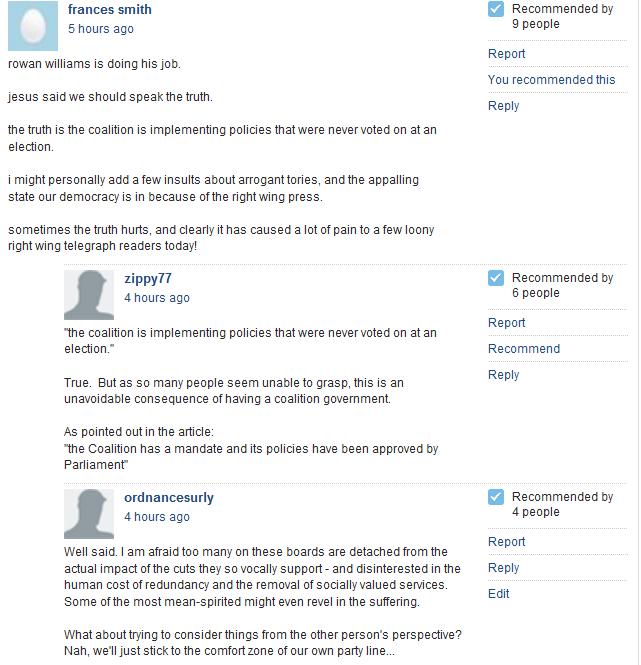

But then there were the absurdly sanctimonious Thatcher fans, talking about toxicity without reference to the Iron Lady as the defining influence on modern Blighty:


Needless to say, there was no response to my last points.

I was baffled by the odd religious 'vision' of jeongu, which they were not willing to clarify for me:


Dynamic phrases such as 'the frocked coward' are routine on these boards. People without any sense of balance or even awareness of how even-handed Williams has been in his comments:


I was able to probe the perennial post-Thatcher Tory tensions: between loving the free-market and hating immigration, the EU and immigrants:


I note the maniacal conspiracy theorist, PP, who provides no link to evidence backing up his fraud claim or the electoral statistics that would prove it made the difference:


Such absurd hyperbole from Edward Green, that made me link to this famous old clip of Jimmy from The Fall and Rise of Reginald Perrin - oh, and yes: I got told to read Hayek, after suggesting that the bellicose nutter might read a true 'conservative' like Edmund Burke... 


'Rabid emotionalism' seems about right to me. Their 'realism' is a fantasy:


They conflate individuals' debt with government debt; the old 'we've maxed out the nation's credit card!' stupidity, again not fully understanding Rowan Williams's longer-term position and consistency:

The above bit on the role of the church was actually my first entrance into the debate, highlighting what I would have thought were obvious points.

The other article that was graced by an ordnancesurly intervention was a shoddy piece of work from Cristina Odorne, bizarrely - on this evidence - a former deputy-editor of The New Statesman. An admitted Tory voter in 2010, Odorne is also a Catholic, and one would at least expect a temperate view to be taken with the head of the Church of England. However, she attempted to score points in precisely the manner she was accusing Williams of doing. This is truly the sort of journalistic trifle that could have been thrown together without even having read RW's words, and makes Brogan's comments seem a model of sanity in comparison. It is a stock response that one can imagine she had filed away ready for the next time Williams came into the news. When it turns out that his comments are not slavishly approving of the Tory policies of the Coalition, then it is fair game for the attack dogs to be unleashed!

Attack dogs who do not fail to trot out this sort of tired nonsense, which has been thoroughly discredited post-economic crisis, if it was not before:


It was good to have had some support in the debate, as from norto here. While I suspect he/she (though, he really... when have women been known as avid frequenters of DT comments-threads?!) may be a bit of a Blue Labourite, good points were made. 


This article did receive far more critical comments, attacking the style of writing and half-baked arguments, but there was still a nauseating level of support - as one would expect:


I made a few more contributions to that thread, but I think that is an appropriate note to end on. I doubt I will be logging onto the DT's site on a regular basis - it would frankly be a waste of time. Much better to argue with open-minded people elsewhere, and try and steer the discussion on the Guardian CIF threads in the right direction. There are articles to write, there is music to make and listen to; there are interesting films and television programmes to watch. There are indeed people to meet in the outside world and communicate with online. It would be a dead end to spend time trying to destabilise a stultefying discourse. Only the occasional intervention on certain issues. Maybe my next intervention will be with that vile organ, the Mail - so rightly attacked by the Speaker of the House of Commons last week. One that has a far greater readership and influence than the Torygraph.

Sunday, 27 February 2011

Edgelands and left-wing fogeyism

http://www.newstatesman.com/blogs/cultural-capital/2011/02/british-problem-auden-moss


During my customary, leisurely read of the New Statesman on Saturday, two particularly interesting book reviews struck me. One might also highlight Rachel Cooke's political reading of South Riding but I am holding off from commenting on that until I have read more of the novel (currently 40 pages in) and watched the 1970s and 2011 TV-adaptations.

Firstly, Ken Worpole's review of Paul Farley and Michael Symmons Roberts' Edgelands: Journeys into England's True Wilderness, two poets' enquiry of our 'bastard countryside': 'Like their hero John Clare, they have found their poems in the fields'. Worpole begins by mentioning independent-minded Marxist Raymond Williams' The Country and the City (1973), which explained that stark distinctions and demarcations between country and city were no longer valid. He then mentions a similarly-minded 'ecological polemic', Richard Mabey's The Unofficial Countryside and also the anarchist Colin Ward and sociologist Dennis Hardy's writings about life "on the margins", in areas not simply city or country or suburb: 'where they found plotlands, allotments, caravan sites, camping grounds, small-holdings and children's hiding places, as well as outposts of artisan industry.'

As well as books I plan to read like Roger Deakin's Waterlog: A Swimmer's Journey Through Britain (1999) and Wildwood: A Journey Through Trees (2007) and Robert Macfarlane's The Wild Places (2007), one is brought to mind of two television programmes. Firstly, Jonathan Meades' 'Severn Heaven', which focused on the improvised dwellings and plotlands along the river Severn near Bewdley - which grew up in response to the Great Depression.

Second is Alan Plater's rather neglected BBC1 Afternoon Play, The Last Will and Testament of Billy Two Sheds (2006), which saw the veteran playwright attempting to bring together disparate dissenters (old socialist trade-unionist, a 1960s hippie, disillusioned but chipper career women &c.) against neo-liberalism. They are brought together by their senseof shared community around their allotments, situated just outside the city where Jodie Whittaker's student studies and works part-time in a burger bar.


She comes into contact with this community as a means of unfinished business: her beloved grandfather kept a shed there, and she re-encounters his ghost (a wonderfully warm James Bolam) whenever she re-enters it. He instills in her a non-conformist love not just of stories and dreaming, but of people and places - the allotment and its varied 'eccentrics'. While the play has its significant flaws and moments of ingrained, 2000s-era BBC blandness - inappropriate, bet-hedging choice to have Mercury Rev playing at the end where Plater clearly would have relished some vintage jazz - it is a distinctive writerly piece that takes its time with ideas, characters and ambience. Watched today, it seems a poignant, stranded refugee of the Play for Today ethos amid a largely barren era of British television drama seeming to be hypnotised by Hollywood.

Worpole's review makes decidedly relevant mention of Owen Hatherley's A Guide to the New Ruins of Great Britain (2010) and Paul Kingsnorth's Real England: A Battle against the Bland (2008). It is interesting to compare Kingsnorth's intensely felt localism and (Deep, if one considers the whole Dark Mountain project) Ecologism with Hatherley's feeling for European socialist futurism. It may seem difficult to bridge the divide between socialist urbanism and anti-growth small-is-beautiful ecology, but both writers share a concern with urban localism disappearing: they variously document Sheffield and London working-class markets under threat. Perhaps Rob Young's Electric Eden: Unearthing Britain's Visionary Music (2010) has a place in this, mentioned approvingly in The Wire's end-of-2010 highlights by another excellent Zero Books author, Nina Power.
 
Some Green writers, such as Ernest Callenbach, are excellent on encouraging an ecological greening of city life, but also in stressing human interactions, neighbourhood diversity and Enlightenment values. The promotion of open public spaces (and parks), education and public transport can surely unite socialists and ecologists. Callenbach, author of an interesting-sounding ecological utopian novel, Ecotopia (1975), is no Luddite, but promotes a selectivity about technology. He actively encourages city apartment block living as ecologically and socially preferable to the sort of suburban or rustic retreats presumably beloved of many romantic British environmentalists - who tend to share the architectural outlook of Pevsner or Betjeman. I think there has to be a middle-ground on this - an encouragement of enlightened city values first and foremost and a defence of modernist architecture up to a point. It would be folly to say that Newcastle Upon Tyne would be a better city if its Georgian heart had been entirely demolished as per T. Dan Smith's masterplan - too many factors mitigated against this: the innate small-c conservatism of many working-class people, the gradual consumerisation of society during the 1945-79 period of social democracy in Britain. 

There has to be unity against capitalist materialism and by definition this has to include over-consumption, which lead to the sort of bland environment documented in Chris Petit's rather haunting recent TV documentary/essay, Content (More4, 2010) - intriguing reflections on the influence of technology and neo-liberalism dominance over the marginal spaces explored also by Patrick Keiller as well as Meades.


The second book review that interested me was Geoffrey Wheatcroft on David McKie's Bright Particular Stars: a Gallery of Glorious British Eccentrics, not so much for the comments on the book itself - fascinating and enjoyable though that sounds - but more for Wheatcroft's assessment of McKie himself. This long-time Guardian writer has published extensively on British politics and more recently on the eccentric and locally distinctive. Wheatcroft places him as perhaps the last of a breed of provincial, non-metropolitan left-wing writers and journalists:

'As his discerning fan club knows, McKie himself is, if not eccentric, salty, sesquipedal and offbeat,but also alittle poignant, as befits one of the last of an endangered species or tendency. It might be called the fogeyism of the left - "Radicals for cricket, railways and real ale" - which once had a billet at the Guardian, whose deputy editor McKie was, and where he later wrote the Elsewhere and Smallweed columns.

There was a time when that paper, too, or rather the Manchester Guardian as was, embodied certain virtues - dissenting, unfashionable, provincial - which are today not so much discounted or despised, as quite vanished. Much more significant than the politics of our media now is their tone: modish, sneering, intensely metropolitan. It is a world that would have disconcerted not only McKie's far-flung villains, but also his heroes.'

One could mention Alan Garner, Alex Glasgow, Jake Thackray, Hunter Davies, Alan Bennett, Dennis Potter and - of course - Alan Plater as others not writing from an exclusive, metropolitan mindset. Who do not automatically sneer at most life outside the capital or assume the worst of people; who embody a kind of humane socialism alien to the patronising, would-be left-liberals, the lifestylers of today. Of course, there are exceptions among those born after 1940; those not entirely giving themselves over to the new individualism: Paul McCartney and Michael Palin to an extent; Roy Harper, Robert Wyatt and Kevins Coyne and Ayers for sure. There were of course English libertarians to whom neo-liberalism was absolute anathema, but who had to play the game.

The 1930s born generation were the last to have personal memories of the Great Depression or WW2. I have written previously about Robert Westall, born just a few months earlier in 1929, though no one embodies the particular generation's strain of socialism as well as Alan Plater. Jazz over rock 'n' roll. Social liberalism within the context of strong social institutions and bonds; an interest in people and life rather than the iconography of self-destruction that is the hallmark of the rock 'n' roll cult.

'All I would say is that those whom with some deliberateness I called enemy artists — I don’t just see
them as different, I see them as enemy — endlessly harp on the failure of relationships, the dislocation of communities, the defeat of noble efforts, the end of idealism. This really is the only thing with which they can defend this social order: not that it’s good, but that it’s inevitable.

People aren’t good enough to live in better ways — this is the heartland of their system. They don’t any longer try and say it’s better. They just say, ‘We understand people, we know they’re out for themselves, we know that if they try something good it fails.’ And because of that there is what I called a bourgeois dissident form of art which shows all this with great power . . .

Everyone who has lived in this actual world already has enough doubts, has enough knowledge of weakness
and of how often things fail. It may be some kind of therapy to see it endlessly replayed, but the moment when
people feel the break from the possibility that at least something can move, some-thing can be got right,
something can be felt . . . I think that at the moment, that kind of celebration of possibility is the most profound
need.'

(Raymond Williams, quoted in: BRITTON, Andrew, ed., 1991, Talking Films: The Best of
Guardian Film Lectures
, London: Fourth Estate. p.127-9)

'Will Trotter, who runs the drama outfit there, approached me with a proposition. Essentially, it went like this:

"Would you like to write an Afternoon Play?"

"Tell me more."

"This is the fourth series. We get a very good audience share, which is why they're letting us do some more. But there's a down side."

"Tell me more."

"Because it's an afternoon slot, you've got to shoot an hour-long play in eight days with two cameras. And everyone's paid less - but it goes up again if you get a peak-time repeat, and that's beginning to happen."

"Tell me more."

"Again, because it's an afternoon slot, there's no explicit sex, no drugs, and nobody's allowed to say 'shit' or 'fuck'."

"You've just described Jack Rosenthal's career. And mine, too. If we can ban rock'n'roll as well, you're on."

(Alan Plater, 'The Renaissance of the Standalone Drama', The Independent, 17 January 2006, http://www.independent.co.uk/news/media/the-renaissance-of-the-standalone-drama-523379.html)

Friday, 14 August 2009

Same old lies


So, the nutters find an ally to peddle this hateful nonsense.

Obama's plan isn't even looking to establish a health service free at the point of use; he isn't Nye Bevan, more's the pity - but, he is looking to moves things in a better direction.

'Eccentric' views, eh, Mr Cameron? He well knows that the Daniel Hannan position is representative of many in his party... why should anyone believe the NHS would be safe in Tory hands? Cameron is following to the letter Thatcher's strategy of saying as little as possible before getting into power. It is so frustrating to see Prescott and others making the right sort of noises on this now, when they have so comprehensively rejected the collectivist way of thinking embodied by the NHS in how they have governed this country. Quite a perceptive piece on current signals from Cameron here: http://www.guardian.co.uk/commentisfree/2009/aug/14/alan-duncan-expenses-cameron-tories

So, the worst side of America comes in the open, yet again; erroneously trying to use Stephen Hawking and others to back up their campaign. We do things differently here, at least on this topic. There is vast public support for, yes, our socialist way of doing health - it is about caring best for all in the country.

Wednesday, 13 May 2009

39. Oscar Wilde - 'The Selfish Giant' (1888)


'He's bought a building! He's bought a building! Great!
(Cassetteboy, 'I Am the Guv'Nor, You Deal with Me', Carry on Breathing, 2008)

'it was so long since he had heard a bird sing in his garden that it seemed to him to be the most beautiful music in the world.'
(Oscar Wilde, The Complete Oscar Wilde, New York: Quality Paperback Book Club, p.292)

Not so much deployment of the paradox; little of the sophisticated wit of the kind one might expect of this writer. Instead, socialist - or even Communist - allegory with implicit, verging upon explicit, denunciation of the idea of private property.

The Selfish Giant erects in his garden a notice-board with the words : 'TRESPASSERS WILL BE PROSECUTED' - shown centred on the page in a box. An ancient and modern mantra of those who would lay claim to land. Today, property ownership may be a smugly infantilised game - Channel 4's programmes such as Property Snakes and Ladders - and assumed 'right'. Meaning we are just as in need of Bertram Ingledew's astonished indignation and Cassetteboy's ingenious, hilarious and righteous Morrisian cut-ups.

The British obsession with owner occupation - leading often to a metaphorical lowering of the drawbridge against the world and other people - is a key part of why are a less civilised nation than, say, Germany. Also partly why we are so Conservative at the ballot box.

The sublimely sneaky, subversive 'A Sphinx without a Secret' is more redolent of the Wilde one expects from the plays and the life, with its piercing view of romantic rituals and bourgeois city life. This is more simple, on-the-surface rather than concerned with surfaces; there is an almost anti-Wildean simplicity at work, for example, 'He was a very selfish Giant' is indented as a paragraph on its own.


Grasping acquisitiveness gives way to generosity and nature; a vision somewhat in line with that of Hans Christian Andersen. The Wildean mark is clear in how he characterises the Giant at the beginning; he returns home after seven years staying with his friend the Cornish ogre: 'After the seven years were over he had said all that he had to say, for his conversation was limited, and he determined to return to his own castle.' (p.291) That he lacks conversational skills does not sit well with the convivial Wilde, whose table talk was legendary and often facilitated his creativity; it marks the Giant out as bad and limited, in comparison to the communal harmony of the children who he finds playing in his garden.

Typically for both allegory and the Wildean fairy tale, the elements and seasons are personified; Autumn, for example, acts to punish the giant by withholding her fruit from his garden: ' " He is too selfish," she said. So it was always Winter there, and the North Wind and the Hail, and the Frost, and the Snow danced about through the trees.' (p.292) This anti-realism reflects how rooted in tradition Wilde was; sometimes he subverts it, but always he draws upon it - for example, the deployment of tropes from Victorian Melodrama in his early plays.

Nature, as in Andersen, works to negate the evil in individuals, and provides for communality to re-assert itself at the end. Indeed, white blossom serves as a symbol of the Giant's moral ascension, described as covering his dead body at the close.

To get a true sense of Wilde, one must go beyond the plays; an understanding of them is to be enriched by perusal of his essays and short-stories - which reveal an ardent socialist and anti-Wienerite, brethren of William Morris and in line with other such currents in post-1850 literature and culture. While I prefer 'Sphinx' to this, it has to be stressed that they each inform the other; irreverent social satire and absurdity given the ballast of Christian Socialism, and vice versa.

8/10

Saturday, 14 March 2009

Ring in the new...

“I felt in a way it’s a recompense for the education I was given [...] I went to a state school in Leeds. I went to Oxford on a scholarship. I benefited at every stage from the nanny state, as it is disparagingly called. It would be unimaginable now to be a student and free of money worries. But I was lucky in my time and I’m grateful to be nannied.”


(Alan Bennett, quoted in The Economist, 23/10/2008)

"Will there be honey
In a northerly sea
For a well-behaved enterprise culture?"

(Sudden Sway, ''76 Kids Forever', '76 Kids Forever, 1988)


'O! Start a revolution, somebody!
not to get the money
but to lose it all for ever.'

(D. H. Lawrence, 'O! Start a Revolution', 1927)

"Quite evidently, the people of this country don't want anything to do with the people up north, or with the communist way of life."

(J. G. Ballard, Theatre of War, 1977, The Complete Short Stories, Vol.II, p.457)

"It seems to me that someone of your principles would fit comfortably into almost any government. All regimes require people like you, who seem to be prepared to obey orders without question. Unwavering obedience guarantees success in any administration. It also guarantees collaboration in every atrocity in which a government might engage."

(George Monbiot, addressing Hazel Blears, The Guardian, 10/02/2009)


I hail the crier to this sodden patch of ground, an obscure corner of the www where shingle meets raincoat, to quote the venerable Sudden Sway. To get the full epoch-making significance of this latest venture play The Advisory Circle's 'Fire, Damp and Air' on looped repeat.

The remit is to provoke, converse (occasionally soliloquise) and make links between many areas of culture: literature (short stories, novels, drama, poetry), music (popular and otherwise, the old Abba to Yello and new Camera Obscura to Witty Boy continuum) politics, local history and travelogue. Nothing is separate, cordoned off and irrelevant, to be discussed in solitary confinement. Even Noel (Edmonds)’s HQ, God help us, is worthy of mention, even as an example of what we are up against…

Britain, Europe, North America, the world; nothing is out of bounds; there is the imperative to engage with America once again, now that the disastrous regime has departed and the better side of that country is asserting itself - could one imagine Bush or even Clinton making the speeches Obama is making at the moment regarding the bonuses? The north in general exerts its hold; Canada, Scandinavia, Scotland and the benighted North of blighty seem to form in many ways a possible cultural-political alliance against the simplicities of Palin, the banalities of Cameron and Hollywood sentimentality.

I may even dabble at some original short stories (you are warned to set up an exclusion zone forthwith), psycho-geographical travel writing, there will be a sequel to chart writing such as this: http://tom-may.livejournal.com/2008/03/02/ (am willing to admit I may have got some things badly wrong there, being fallible and no omniscient authority). Left-wing politics, in this time when we are witnessing the collapse of Thatcher-New Labour free-market capitalism, will naturally inform my perspective. The seemingly contradictory poles of Wilde and Bevan will serve as an example of future paths we have [frustratingly] yet to take. I can make no coherent philosophy other than to say that certain principles must stand: ordinary people deserve the very best rather than to be patronised, artists have the right to self-expression free of censorship; public service is an ideal to be defended – the right (or, left) sort of nanny can be beneficial, as Alan Bennett has argued and John Peel or Oliver Postgate demonstrated.

I also hope to include, as this project develops, fictions of my own (set up the exclusion zone, marras), examples of photography and my evolving music, if possible within these confines. I certainly feel that Blogger offers more of these opportunities than Live Journal; for example, it is far easier to upload images: essential for any psycho-geography or chart-writing.

The immediate rubric, designed to ensure that this thing gets up-and-running, is to establish a regular series: for me to read and review a short-story a day. I will draw from my own partial experience and knowledge, in order to assess the literary - a fine way of actually reading and comparing many writers I have shamefully never read before.

I will express gratitude again for the examples set (and occasional encouragement from) of fellow internet writers, who continue to exert influence: Simon Reynolds, Marcello C. & Lena, Robin Carmody, k-punk and Owen Hatherley. Monbiot, Morley, Meades, Kermode and (to a point) Brooker, voices on the fringes of the mainstream media must be commended, in this world of Myersons and stultifying middlebrow - last Friday's tedious Newsnight discussion 'Is Television Dead?' being a prime exhibit with its vested-interest industry insiders and cliche-spouters, sorely lacking in a Tom Paulin figure, an actual critic (now removed from our screens due to, my word, expressing some political views).

Real-world friends and colleagues who remain an inspiration ought to be thanked; they know who they are. I should also give 'shout-outs' to benign institutions that I am certain will prove invaluable in various ways: You Tube, Project Gutenberg, Wikipedia, the Star and Shadow Cinema, Sunderland and Newcastle public libraries... This is important; it must be refuted that we are a broken society or all doomed or all such; we have been immersed in one of the more shallow phases of our civilisation, but everything passes, and the opportunity is clearly there to make the change - and, I'm sorry anarchists - public and open-source institutions have a role to play in that.

The old place, Quiet Talks and Summer Walks, will remain, but restricted more purely to spur-of-the-moment reactions and comments, more fragmentary vignettes. The more considered pieces will from now on be on here.

Please comment or ‘follow’ as you will, though I would naturally prefer the term comrade, or friend, to follower. I do not set my word down as sacrosanct but hopefully worthy of kind correction and non-rancorous nattering, over virtual – and none-too-nourishing – pints of Old Peculier or careworn black coffees.

Follow TAC's 'Fire, Damp and Air' with Roy Harper's 'Commune', and let's have some audacity.